
How Much Does a Paver Pool Deck Cost in South Florida?
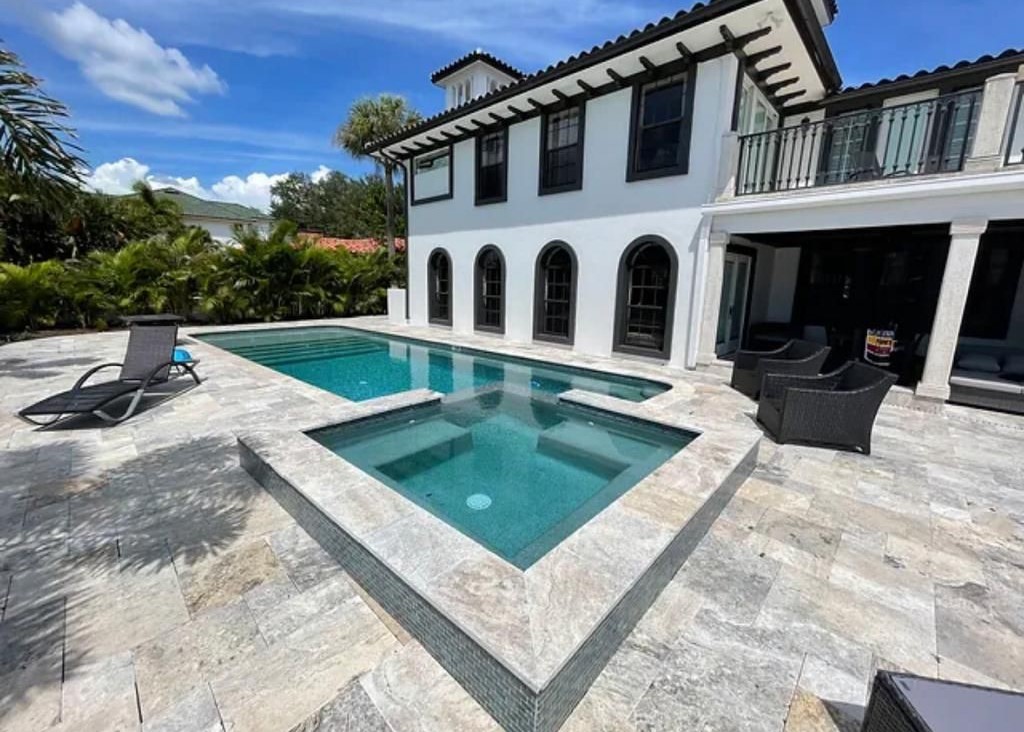
PAVER POOL DECK COST
IN SOUTH FLORIDA
Material matters, but it is only one part of a paver pool-deck estimate. Demolition, base preparation, drainage, coping, layout complexity, access, and coordination with broader pool work can all shape the final scope — so a per-square-foot number alone is rarely the whole story.
A paver pool deck can change how an entire backyard looks, feels, drains, and functions. It can also be difficult to price from a photograph or square-foot measurement alone.
Material matters, but it is only one part of the estimate. Removing an existing deck, preparing the base, correcting drainage, replacing coping, working around curves and raised features, and coordinating the deck with a broader pool remodel can all affect the final scope.
This guide explains the planning ranges South Florida homeowners may encounter, what those figures may or may not include, and how to compare proposals without assuming that the lowest per-square-foot number represents the same project.
- 1. The Short Answer
- 2. Paver Pool Deck Cost Planning Ranges
- 3. What a Paver Pool Deck Estimate May Include
- 4. How Material Choice Affects Cost
- 5. Deck Size, Shape, and Layout
- 6. Demolition, Overlay, and the Existing Surface
- 7. Base Preparation, Drainage, and Slope
- 8. Coping, Steps, Borders, and Transitions
- 9. Site Access and Project Coordination
- 10. What May Be Priced Separately
- 11. How to Compare Paver Pool Deck Estimates
- 12. Paver Pool Deck Budgeting Checklist
- 13. Frequently Asked Questions
The Short Answer
For preliminary November 2026 planning, published South Florida installer ranges commonly place:
- Concrete paver pool decks around $14 to $22 per square foot installed
- Travertine, marble, or comparable natural-stone pool decks around $18 to $30 per square foot installed
- Porcelain paver pool decks around $20 to $34 per square foot installed
These are general third-party planning ranges, not Precision Pavers & Pool Design quotes. They should not be multiplied by your deck area and treated as a final project price.
Published local figures vary because the quoted scopes vary. One contractor may include demolition, base preparation, bedding material, edge restraint, joint material, and cleanup. Another figure may describe decking over a prepared surface while excluding coping, drainage corrections, sealing, permits, or removal of the existing deck.
The useful question is not simply, “What is the price per square foot?” It is:
What work, materials, preparation, and related pool-edge details are included in that number?
If the deck is part of a larger renovation, start with the South Florida pool-remodeling planning guide so the deck is evaluated alongside the pool finish, tile, coping, and other project components.
Paver Pool Deck Cost Planning Ranges
The following figures are intended for early budgeting only. They summarize published South Florida pricing information reviewed in November 2026, including ranges from J. Perry & Sons and project examples published by Custom Watershapes.
They do not represent Precision pricing, a guaranteed market average, or a substitute for a written project-specific estimate.
| Project or material category | General planning range | What may be included | Common cost variables | Important qualification |
|---|---|---|---|---|
| Concrete paver pool deck | $14–$22 per sq. ft. | Pavers, standard base preparation, bedding material, joint material, edge restraint, and installation may be included | Paver collection, finish, pattern, demolition, drainage, cuts, borders, and access | Third-party South Florida planning range; confirm the exact written scope |
| Travertine, marble, or comparable natural-stone deck | $18–$30 per sq. ft. | Stone, installation materials, standard preparation, setting, joint treatment, and cleanup may be included | Stone type, grade, finish, thickness, pattern, waste, coping, substrate, and access | Natural-stone products and installation methods are not interchangeable |
| Porcelain paver pool deck | $20–$34 per sq. ft. | Porcelain pavers and the specified installation system may be included | Product thickness, installation method, cutting, substrate, drainage, edge details, and access | Porcelain installation requirements can differ from concrete pavers and natural stone |
| Published local project examples | Approximately $5,500–$10,000 for certain 600–800 sq. ft. stone or concrete-paver decks | Scope varies by the contractor and project example | Size, material, finish, pattern, removal, base work, and related pool details | Do not compare this total directly with a per-square-foot range until inclusions are confirmed |
| Full replacement or coordinated pool-deck renovation | Site-specific estimate required | May combine demolition, disposal, base work, drainage, coping, deck installation, transitions, and related pool work | Existing conditions and the complete project scope | A generic square-foot figure is least reliable for complex renovation work |
What rough square-foot math looks like
For a hypothetical 500-square-foot deck, simple multiplication produces these early planning figures:
- Concrete pavers: approximately $7,000 to $11,000
- Travertine, marble, or comparable natural stone: approximately $9,000 to $15,000
- Porcelain pavers: approximately $10,000 to $17,000
That arithmetic is useful for deciding whether a project deserves further investigation. It is not a quote.
A smaller or highly detailed deck may have a higher effective cost per square foot because mobilization, cutting, edge work, and setup do not shrink proportionally. A larger open deck may use more material overall but allow installation work to proceed more efficiently.
The existing surface and related pool-edge work can also move the actual project well outside simple material-based math.
What a Paver Pool Deck Estimate May Include
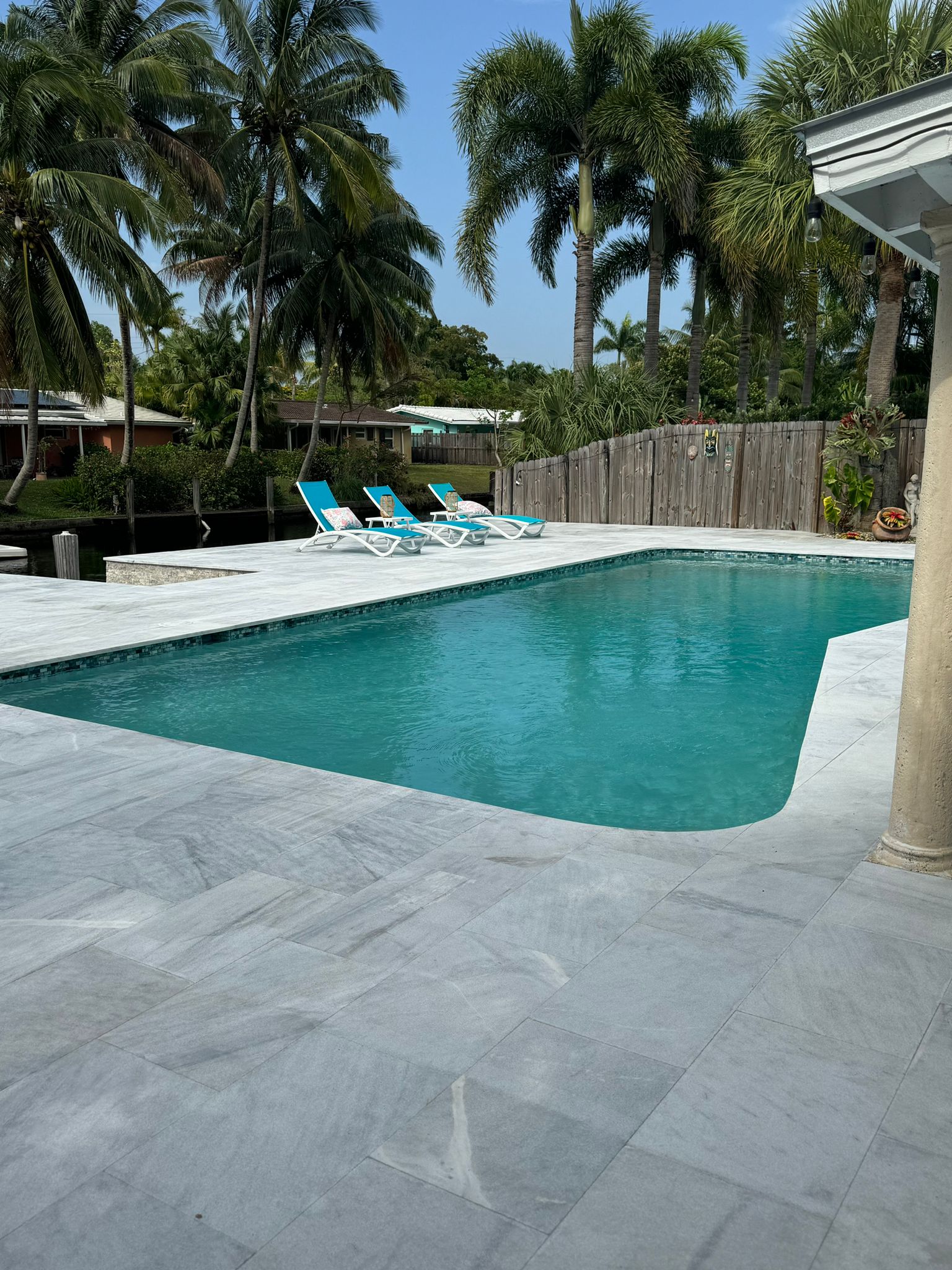
A useful proposal should explain the work behind the number. Depending on the project, a paver pool-deck estimate may address:
- Site protection and preparation
- Removal and disposal of existing materials
- Excavation or surface preparation
- Base material and compaction
- Bedding or setting materials
- The selected paver or stone product
- Layout and pattern
- Cuts around curves, drains, steps, columns, and equipment
- Edge restraint
- Joint material
- Coping and pool-edge transitions
- Drainage components
- Final cleanup
- Sealing, if included and appropriate for the selected material
- Permit or approval costs, if applicable and specifically included
The phrase “installed price” does not have one universal definition. Ask the contractor to identify what is included, excluded, optional, or dependent on conditions discovered after demolition.
Precision’s pool-deck remodeling service can be evaluated as a focused deck project or as part of a broader pool transformation. For hardscape projects beyond the immediate pool area, the driveway and patio paver service provides additional context.
How Material Choice Affects Cost
Material selection affects more than the purchase price. It can also change the installation method, cutting requirements, waste allowance, joint treatment, maintenance expectations, and the details available for coping and borders.
Concrete pavers
Concrete pavers are available in many colors, shapes, textures, and patterns. Their cost can vary considerably between basic collections and more detailed or premium finishes.
The final number may also change with:
- Paver size and thickness
- Pattern complexity
- Contrasting borders
- Specialty shapes
- Detailed cuts
- Product availability
- The amount of waste needed for the layout
Homeowners comparing this category can review Precision’s brick and concrete paver options while keeping in mind that a product-page selection does not establish the complete installed scope.
Travertine and marble
Natural stone is often considered for South Florida pool decks because of its appearance and the way lighter selections may feel in strong sun. However, “natural stone” is not one uniform product category.
Stone type, grade, finish, thickness, color variation, pattern, edge treatment, and installation requirements can all affect cost. The proposal should identify the exact product rather than using only a broad label such as “travertine” or “marble.”
See the dedicated travertine paver and marble paver pages for material-specific context.
Porcelain pavers
Porcelain can support a clean, contemporary design, but the installation system matters. Belgard notes in its porcelain-paver installation guidance that porcelain products can require different handling and installation considerations than traditional interlocking concrete pavers.
That means a porcelain material price should not be compared with another category without also comparing:
- Product thickness
- Substrate
- Setting method
- Joint treatment
- Cutting requirements
- Edge details
- Drainage approach
For a broader comparison of appearance, heat, texture, maintenance, and project fit, use the South Florida pool-deck materials guide.
Deck Size, Shape, and Layout
Square footage affects material quantity, but geometry affects labor.
A simple rectangular deck with long uninterrupted runs is different from a deck containing:
- Curved pool edges
- Freeform shapes
- Raised spas
- Multiple elevations
- Steps or sunken areas
- Columns
- Planters
- Equipment pads
- Narrow side-yard sections
- Numerous drains
- Turf or landscape inlays
- Contrasting borders
- Multiple pattern changes
Every interruption can require measuring, cutting, alignment, and additional material.
Pattern choice matters too. A straightforward running-bond layout may create a different labor and waste profile than a more detailed pattern with borders, medallions, or frequent directional changes.
When comparing proposals, confirm that each contractor measured the same deck area and included the same layout details. A lower square-foot figure may be based on a simplified interpretation of the project.
Demolition, Overlay, and the Existing Surface
One of the largest scope differences is whether the new pavers will be installed over an existing surface or whether the old deck must be removed.
Overlaying an existing concrete deck
An overlay may reduce demolition when the existing slab and surrounding conditions are suitable. It is not automatically appropriate simply because concrete is present.
Belgard’s guidance on installing pavers over concrete emphasizes evaluating the existing surface and maintaining proper drainage. The additional finished height must also work with coping, doors, drains, steps, thresholds, and adjacent areas.
Questions to evaluate include:
- Is the existing surface stable?
- Are cracks, movement, or settlement present?
- Will the new elevation interfere with doors or thresholds?
- Can drainage still function correctly?
- How will the overlay meet the coping?
- Can edge conditions be finished properly?
Full removal and replacement
Removing an old deck adds demolition, labor, hauling, disposal, and site preparation. It may also expose base, drainage, or transition conditions that were not visible during the initial walkthrough.
Full removal can provide access to rebuild the supporting system, but the scope should clearly explain what happens if unsuitable material or unexpected conditions are uncovered.
If resurfacing, tile, coping, and decking are being considered together, review the guide to replacing pool tile, coping, and decking during resurfacing. Coordinating those decisions before work begins can prevent one new component from conflicting with another.
Base Preparation, Drainage, and Slope
The attractive surface receives most of the attention. The supporting work underneath it often determines how the completed deck performs.
Belgard’s paver installation guidance identifies a properly prepared and compacted base as a fundamental part of the installation system.
Existing conditions may require different levels of work:
- Removing unsuitable material
- Correcting low or uneven areas
- Adding and compacting base material
- Preparing a bedding layer
- Establishing appropriate elevations
- Preserving drainage paths
- Integrating deck drains
- Directing water away from structures where required
- Protecting the relationship between the deck and pool edge
South Florida rain makes drainage planning especially important. A proposal should not treat slope, drains, and transitions as afterthoughts.
The Pool & Hot Tub Alliance also identifies slip-resistant pool-deck surfaces as an important safety consideration. Product selection, surface texture, drainage, maintenance, and installation all influence how a deck functions when wet. No material should be described as universally slip-proof.
A low proposal that omits necessary base or drainage work is not necessarily a lower price for the same finished project. It may simply describe less work.
Coping, Steps, Borders, and Transitions
Coping forms the transition between the pool shell and surrounding deck. It may be priced separately from the main deck surface, especially when it uses a different product, thickness, edge profile, or installation method.
Cost can be affected by:
- Total linear footage
- Straight versus curved edges
- Raised spas or walls
- Inside and outside corners
- Step details
- Spillways and water features
- Product thickness
- Bullnose, eased, square, or specialty edges
- Matching or contrasting materials
- Removal of existing coping
- Coordination with waterline tile
- Deck-to-coping elevation changes
The South Florida pool-coping materials guide explains the design and performance considerations in more depth.
Borders and transitions can also add labor even when they use the same paver collection. Ask whether the proposal includes soldier courses, contrasting bands, transitions to patios or walkways, and connections to existing hardscape.
Site Access and Project Coordination
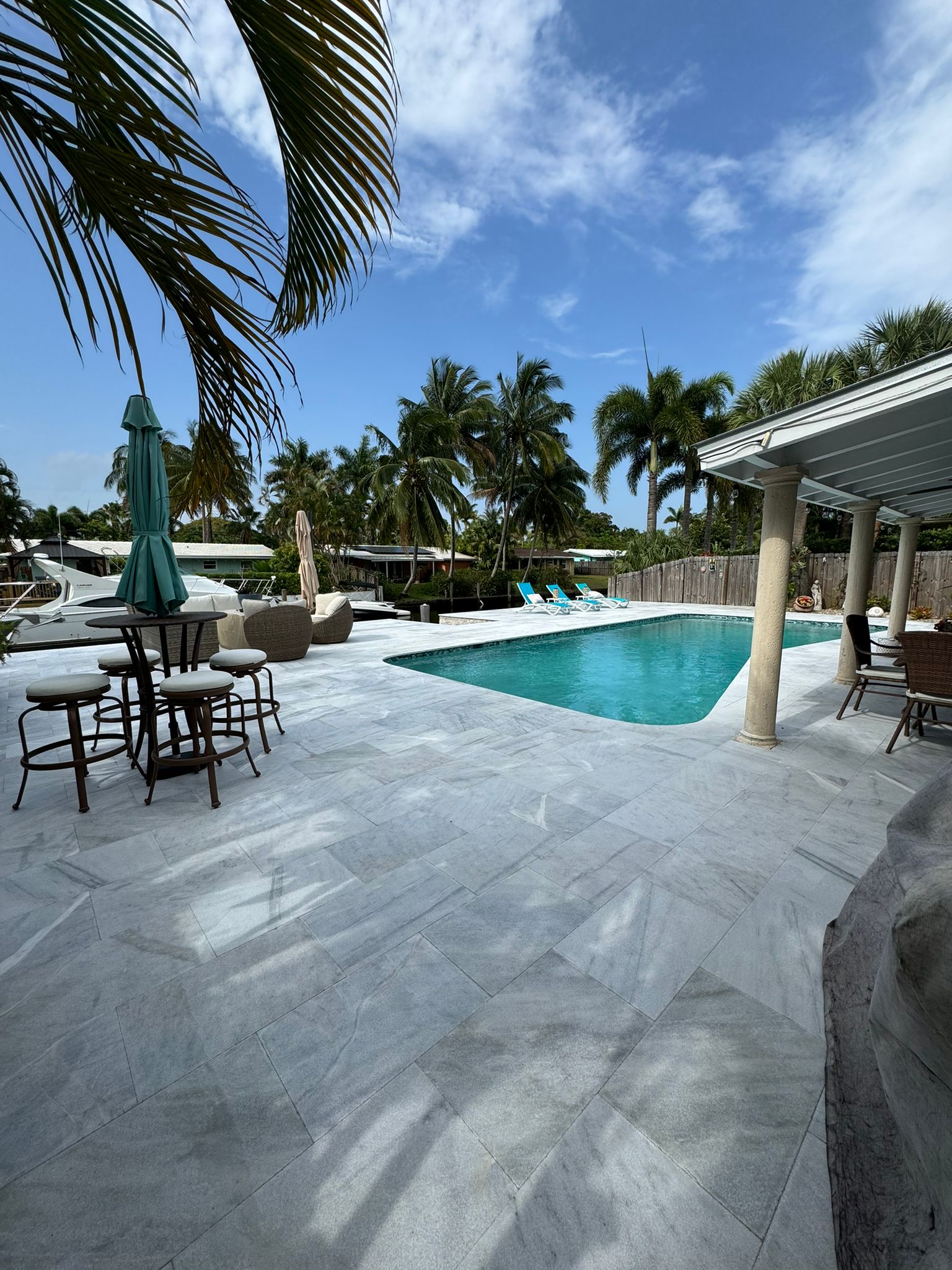
Two decks with the same square footage can require very different installation plans.
Site-access factors may include:
- Narrow side yards
- Gates
- Stairs or elevation changes
- Limited staging space
- Distance from the street
- Landscaping that must be protected
- Screened areas
- Waterfront conditions
- Occupied outdoor spaces
- Equipment-access limitations
- Restrictions on where removed material or new products can be staged
These factors can affect how materials, equipment, and debris move through the property.
Coordination matters when the deck is part of a larger project. Pool resurfacing, tile, coping, plumbing work, water features, outdoor kitchens, pergolas, fencing, turf, and landscape work can affect sequencing and access.
If the pool interior is also being renovated, compare the separate South Florida pool-resurfacing cost guide. A pool-finish estimate and a paver-deck estimate may overlap in areas such as demolition protection, coping, tile, access, and cleanup, but they are not the same scope.
What May Be Priced Separately
Do not assume every proposal includes every related task. Depending on the contractor and project, the following may appear as separate items:
- Demolition
- Hauling and disposal
- Base remediation
- Drainage work
- New deck drains
- Coping
- Waterline tile
- Steps or raised features
- Borders and specialty patterns
- Repairs discovered after demolition
- Sealing
- Pressure washing or restoration of retained areas
- Permit or approval costs, when applicable
- Engineering or specialized plans, when applicable
- Pool water management or protection
- Landscape removal or restoration
- Electrical, plumbing, or equipment adjustments
- Furniture or outdoor-feature relocation
A separate line item is not inherently a problem. In many cases, it makes the proposal easier to understand.
The problem is ambiguity. If an item is necessary but neither included nor clearly excluded, the homeowner cannot accurately compare the proposal with another one.
How to Compare Paver Pool Deck Estimates
Do not compare only the bottom-line totals. Normalize the scopes first.
| Scope item | Proposal A | Proposal B | Questions to clarify |
|---|---|---|---|
| Measured deck area | Are both proposals using the same square footage? | ||
| Exact paver or stone product | Are the manufacturer, collection, color, size, thickness, and finish identified? | ||
| Existing-deck removal | Is demolition included, excluded, or unnecessary? | ||
| Hauling and disposal | Are debris containers, hauling, and disposal included? | ||
| Base preparation | What base work and compaction are included? | ||
| Existing slab or substrate | Is the plan an overlay, full removal, or another installation method? | ||
| Drainage and slope | Are drains, elevations, and drainage corrections included? | ||
| Bedding or setting system | What installation system is specified for this product? | ||
| Coping | Is coping included, and what product and edge treatment are specified? | ||
| Cuts, curves, and steps | Are detailed cuts and raised features included? | ||
| Borders and pattern | Does the price include the selected layout and accent details? | ||
| Joint material and edge restraint | What joint and perimeter systems are included? | ||
| Sealing | Is sealing included, optional, unnecessary, or scheduled separately? | ||
| Site protection and access | Are access limitations or protection measures reflected in the scope? | ||
| Cleanup and restoration | What condition will surrounding areas be left in? | ||
| Allowances | Are any products or tasks represented only by allowances? | ||
| Exclusions | What related work is specifically excluded? | ||
| Changes after demolition | How will concealed-condition changes be documented and approved? |
Questions worth asking before signing
Ask each contractor:
- What exact product is included?
- Is the measured area the same as the other proposals?
- What happens to the existing deck?
- What base preparation is included?
- How are drainage and elevation addressed?
- Is coping included?
- Are borders, patterns, steps, curves, and detailed cuts included?
- What work is specifically excluded?
- Which items are allowances rather than fixed selections?
- How are unforeseen conditions handled after demolition?
- Is sealing included or discussed separately?
- How will the deck work be coordinated with any pool remodeling?
A clearer proposal is more useful than a lower number with missing scope.
Paver Pool Deck Budgeting Checklist
Before requesting estimates, collect enough information to make the conversation productive.
Define the existing condition
- Approximate deck dimensions
- Current deck material
- Visible cracks, settlement, loose units, or uneven areas
- Existing drains
- Areas where water collects
- Door and threshold locations
- Coping condition
- Waterline-tile condition
- Steps, raised spas, walls, or water features
- Narrow access points
- Areas that must remain
Photographs are useful for orientation, but they cannot confirm every substrate, drainage, or installation condition.
Define the desired result
- Preferred material category
- Light, medium, or dark color direction
- General style
- Desired pattern
- Matching or contrasting coping
- Borders or accents
- Areas to expand or reduce
- Connections to patios or walkways
- Related pool-resurfacing or remodeling plans
- Maintenance expectations
If you want to compare materials in person, visit the Precision Pool Products showroom before finalizing the scope. Confirm current product details and availability directly rather than assuming every displayed or photographed material is in stock.
Build a realistic planning allowance
Use published cost ranges only to establish a preliminary conversation. Then allow room for project-specific items such as:
- Demolition
- Base corrections
- Drainage
- Coping
- Detailed cuts
- Access
- Sealing
- Related pool work
- Conditions found after removal
Belgard’s outdoor-project budget guidance also recommends considering material and project size as part of early planning. The written project scope—not an online calculator—should control the final decision.
Frequently Asked Questions
Q:How much does a paver pool deck cost in South Florida?
Published November 2026 South Florida planning ranges commonly place concrete pavers around $14 to $22 per square foot, travertine or comparable natural stone around $18 to $30, and porcelain pavers around $20 to $34. These are third-party planning ranges, not Precision quotes. Demolition, base work, drainage, coping, access, patterns, and related pool work can change the actual project price.
Q:Is concrete paver decking less expensive than travertine?
Concrete pavers often begin in a lower published planning range, but that does not guarantee a lower final project total. The exact paver collection, finish, pattern, demolition, base preparation, coping, and drainage scope may matter as much as the broad material category.
Q:Can pavers be installed over an existing concrete pool deck?
Sometimes, but the existing slab and surrounding conditions must be evaluated. Stability, cracks, drainage, finished height, doors, thresholds, drains, coping, and edge conditions all matter. The presence of concrete alone does not confirm that an overlay is appropriate.
Q:Is demolition included in paver pool deck pricing?
It depends on the proposal. Some published installed ranges include removal and disposal, while others assume a prepared surface or price demolition separately. The written estimate should state whether existing-deck removal, hauling, disposal, and substrate preparation are included.
Q:Is pool coping included with a new paver deck?
Not automatically. Coping may be a separate line item because it is measured by linear footage and may use a different product, thickness, edge profile, or installation method. Confirm the coping material, removal, installation, corners, curves, raised features, and waterline-tile transitions in writing.
Q:What makes one pool deck estimate higher than another?
Differences may come from material selection, measured area, demolition, base work, drainage, coping, detailed cuts, borders, patterns, site access, sealing, or related pool work. Before comparing totals, confirm that both proposals describe the same finished project.
Q:How can I estimate the square footage of my pool deck?
Break the deck into measurable rectangles or other simple shapes, calculate each area, and subtract the approximate pool area where appropriate. Freeform pools, narrow sections, curves, steps, and raised features make rough measurements less reliable. A contractor should confirm the final project measurements and waste allowance.
Q:How do I get an accurate price for my paver pool deck?
An accurate estimate requires a defined material, measured area, evaluation of the existing surface, and a clear scope for demolition, base preparation, drainage, coping, access, patterns, and related pool work. Share photographs and approximate dimensions for the initial conversation, then obtain a written project-specific proposal.
Planning a Paver Pool Deck Project in South Florida?
The right budget begins with a clearly defined scope. Precision Pavers & Pool Design can help you evaluate the existing deck, material direction, coping, drainage concerns, access, and how the deck fits into the broader pool and outdoor-living project.
Bring your ideas, photographs, approximate measurements, and the questions you want answered. If you are still comparing materials, you can also explore the showroom before finalizing the project direction.