
Should You Replace Pool Tile, Coping, and Decking During Resurfacing?
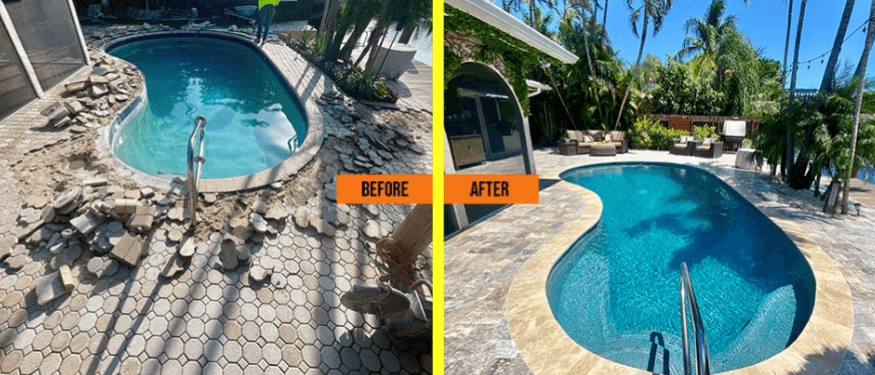
SHOULD YOU REPLACE POOL TILE,
COPING & DECKING
DURING RESURFACING?
Learn when pool tile, coping, and decking should be replaced during resurfacing—and when sound components may remain as part of a coordinated remodel.
Choosing to resurface a pool does not automatically mean its waterline tile, coping, and surrounding deck must also be replaced.
Sometimes the interior finish is the only component that has reached the end of its useful condition. In other cases, resurfacing exposes an opportunity—or a genuine need—to address loose tile, moving coping, failed joints, damaged decking, drainage concerns, or an outdoor space that no longer works as a coordinated design.
The right scope depends on the condition of each component, how those components meet, and what the homeowner wants the completed space to accomplish.
The practical goal is not to replace as much as possible. It is to avoid covering over unresolved problems, damaging new work later, or paying twice for demolition and disruption that could reasonably have been coordinated.
- 1. The Short Answer
- 2. Four Separate Decisions, Not One Automatic Package
- 3. When Pool Tile May Need Replacement
- 4. When Existing Pool Tile May Be Kept
- 5. When Pool Coping May Need Replacement
- 6. When Existing Coping May Be Kept
- 7. Does the Pool Deck Need to Be Replaced?
- 8. Repairing Part of a Deck vs. Replacing the Entire Deck
- 9. Why Sequencing Matters During a Combined Project
- 10. How to Coordinate the Finish, Tile, Coping, and Deck
- 11. A Practical Keep, Repair, Replace, or Evaluate Framework
- 12. Questions to Ask Before Finalizing the Scope
- 13. Frequently Asked Questions
The Short Answer
You should consider replacing pool tile, coping, or decking during resurfacing when those components are deteriorated, moving, incompatible with the new work, or already included in a broader design change.
You may be able to keep them when they are sound, properly bonded, functional, visually compatible, and unlikely to interfere with preparation or installation of the new pool finish.
Each component requires its own decision:
- The interior finish may need resurfacing while the tile and coping remain serviceable.
- Waterline tile may need replacement even when the coping and deck can stay.
- Loose or moving coping may require attention before adjoining finishes are completed.
- A pool deck may need localized repair rather than complete replacement.
- Visible cracking, settlement, drainage problems, or movement may require further evaluation before anyone recommends a cosmetic solution.
This distinction is important because pool resurfacing and broader pool remodeling are related but different project scopes.
Resurfacing replaces the submerged interior finish. Remodeling may include tile, coping, decking, features, equipment, or changes to the pool’s layout and surrounding outdoor space.
Four Separate Decisions, Not One Automatic Package
Homeowners often hear “pool remodel” used as though the pool interior, tile, coping, and deck were one material. They are separate systems that meet at important transition points.
Pool interior finish
The interior finish covers the submerged walls and floor. It affects texture, appearance, water color, and the surface swimmers touch.
Waterline tile
Waterline tile forms the band around the upper portion of the pool. It handles frequent exposure to water, air, sunlight, cleaning, and changing water levels.
Pool coping
Coping caps the upper edge of the pool and creates the transition between the pool shell and surrounding deck. It also provides a finished edge where swimmers may sit, hold, or enter the water.
Pool deck
The deck is the surrounding walking and living surface. Its performance depends on the material, substrate, installation, drainage, movement, maintenance, and site conditions.
Because these components touch one another, work on one can affect the others. That does not mean they must always be replaced together. It means they should be inspected and planned together before the final scope is approved.
Homeowners defining a larger project can use the South Florida pool-remodeling guide to organize the complete scope before making individual material decisions.
When Pool Tile May Need Replacement
Waterline tile may deserve replacement when its physical condition or installation can no longer reliably support the completed project.
Conditions worth documenting include:
- Loose or hollow-sounding tiles
- Cracked, chipped, or missing pieces
- Tiles that have shifted out of alignment
- Deteriorated or missing grout
- Repeated tile detachment
- Open gaps around fittings or transitions
- Heavy deposits or staining that cannot be acceptably restored
- Damage discovered during removal of the existing interior finish
- A tile system that is incompatible with the intended renovation scope
These observations do not identify the underlying cause by themselves. Loose tile, cracking, or missing grout can be associated with several different conditions. The surrounding assembly may need to be evaluated before replacement materials are selected.
The Pool & Hot Tub Alliance’s remodeling and repair guidance identifies damaged tile and coping among the conditions that may need repair or replacement during renovation planning.
Appearance can also justify replacement
Tile does not have to be physically failing for a homeowner to replace it.
A dated tile color, pattern, or scale line may clash with the new interior finish, coping, or deck. When the homeowner is already investing in a major visual transformation, replacing sound but outdated tile can be a reasonable design decision.
That is a preference—not proof that the tile was defective.
Keeping cosmetic preferences separate from physical deterioration makes proposals easier to understand and compare.
When Existing Pool Tile May Be Kept
Existing tile may be worth keeping when it is:
- Securely bonded
- Free from meaningful cracking or missing sections
- Supported by sound grout and adjoining materials
- Compatible with the resurfacing process
- Visually acceptable to the homeowner
- Coordinated with the planned interior finish and coping
- Not concealing a condition that requires repair
A contractor still needs to evaluate how the existing tile will meet the new finish and whether preparation can occur without damaging it.
Keeping tile can help maintain a focused resurfacing scope, but only when preservation makes practical sense. “It looks fine from across the yard” is not the same as confirming that it is sound.
Homeowners should also inspect tile under outdoor light and alongside actual finish samples. The new interior surface can change the perceived color of existing tile once the pool is refilled.
Precision’s glass tile and mosaic options can help homeowners understand the design possibilities when replacement is being considered.
When Pool Coping May Need Replacement
Coping deserves attention because it sits directly between the pool and deck.
Conditions that may support repair, replacement, or further evaluation include:
- Coping units that rock or move under pressure
- Cracked, broken, or missing pieces
- Open or deteriorated mortar joints
- Separation between coping and adjoining materials
- Uneven edges that may create a walking or sitting concern
- Repeated repairs that are no longer holding
- Damage associated with movement in the adjoining deck
- A planned deck replacement that changes elevations, layout, or material transitions
- Coping that cannot be integrated cleanly with the new tile or finish
The presence of one crack does not automatically establish the cause or prove that all coping must be removed. The pattern, location, movement, surrounding materials, and underlying conditions matter.
PHTA’s residential inground-pool standard states that decking, when provided, should be installed in a way that protects the coping tile and mortar bed from damage caused by deck movement. That reinforces an important planning principle: coping and decking should not be evaluated as isolated decorative surfaces.
Reference: PHTA-5 Standard for Residential Inground Swimming Pools
When Existing Coping May Be Kept
Existing coping may remain when it is sound, stable, safe, and compatible with the planned work.
Reasons to keep it may include:
- The units remain firmly bonded.
- Joints are intact or require only appropriate localized maintenance.
- The coping is level enough for its intended use.
- No concerning movement is visible.
- Its profile works with the existing or proposed deck.
- It coordinates with the selected tile and interior finish.
- Removing it would add unnecessary scope without improving the project.
Matching materials should still be considered.
Natural stone, manufactured products, and older pavers may show color variation or weathering. If only a few pieces require replacement, an exact visual match may not be available. Homeowners should see any proposed replacement material before approving a partial repair.
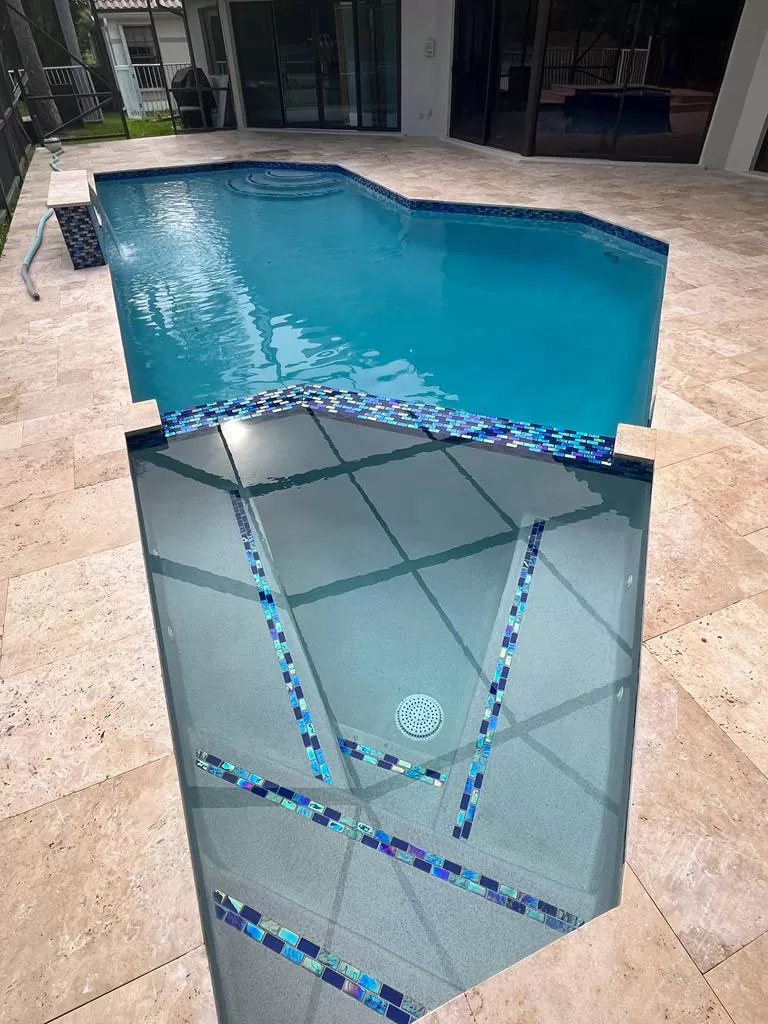
Does the Pool Deck Need to Be Replaced?
No. Resurfacing a pool does not automatically require replacing the surrounding deck.
The deck should become part of the conversation when it shows conditions such as:
- Loose, rocking, or displaced units
- Cracking that is widening, recurring, or associated with movement
- Settlement or uneven walking surfaces
- Areas that hold water
- Drainage that sends water toward the pool or home
- Deteriorated joints at the coping
- Failed coatings or overlays
- Damage that would be disturbed by the planned pool work
- A layout that no longer supports how the homeowner uses the space
A deck may also be replaced for design reasons. Homeowners may want more usable space, a different material, updated colors, improved transitions, or a coordinated outdoor-living area.
Those goals can justify a larger project, but they should not be presented as evidence that the existing deck has failed.
Homeowners still comparing materials should review the guide to the best pool deck materials for South Florida. Precision also provides pool-deck remodeling and broader driveway and patio paver services.
Repairing Part of a Deck vs. Replacing the Entire Deck
Partial repair can make sense when the problem is limited, the surrounding installation remains stable, and compatible replacement material is available.
Examples may include:
- Resetting a limited number of displaced pavers
- Replacing isolated damaged units
- Addressing a small transition area affected by the pool work
- Repairing a localized joint or edge condition
- Correcting a limited surface problem after its cause has been evaluated
Complete replacement may deserve consideration when:
- Problems appear across a large portion of the deck.
- Settlement or movement is widespread.
- Drainage needs broader correction.
- The existing material cannot be matched acceptably.
- Multiple layers or previous repairs complicate another patch.
- The homeowner wants to change the layout, material, or overall design.
- The pool, coping, and deck elevations must be reconsidered together.
There is an important middle ground between one small repair and replacing every square foot. A project might replace the immediate pool-deck area while preserving another patio section, or rebuild a damaged transition without changing the entire outdoor space.
That is why the proposal should identify the precise limits of demolition and new installation.
Why Sequencing Matters During a Combined Project
The pool finish, tile, coping, joints, and deck meet physically. Their installation sequence should be planned before demolition begins.
Poor coordination can create avoidable problems:
- Newly installed materials may be damaged during later demolition.
- A finished edge may have to be reopened.
- Deck elevations may not align cleanly with the coping.
- Tile, coping, and interior-finish transitions may look improvised.
- Drainage decisions may be made after material heights are already established.
- Homeowners may discover too late that a selected material is unavailable or incompatible.
- The pool may need to be taken out of service again for work that could have been coordinated.
This does not mean every component must be installed by one crew or included in one contract. It means responsibility, sequence, access, protection, and transition details should be established in writing.
Before approving the work, ask:
- Which components will be removed first?
- What underlying areas will become visible?
- Who determines whether newly exposed conditions change the scope?
- When will tile and coping be installed relative to the interior finish?
- How will deck work affect coping or adjacent joints?
- Who protects completed surfaces while other work continues?
- Who manages filling and startup after the new finish is installed?
- How will change orders be handled if concealed damage is discovered?
A clear sequence is more valuable than a vague promise that everything will be “taken care of.”
How to Coordinate the Finish, Tile, Coping, and Deck
A coordinated design does not require every material to match. It requires the materials to relate intentionally.
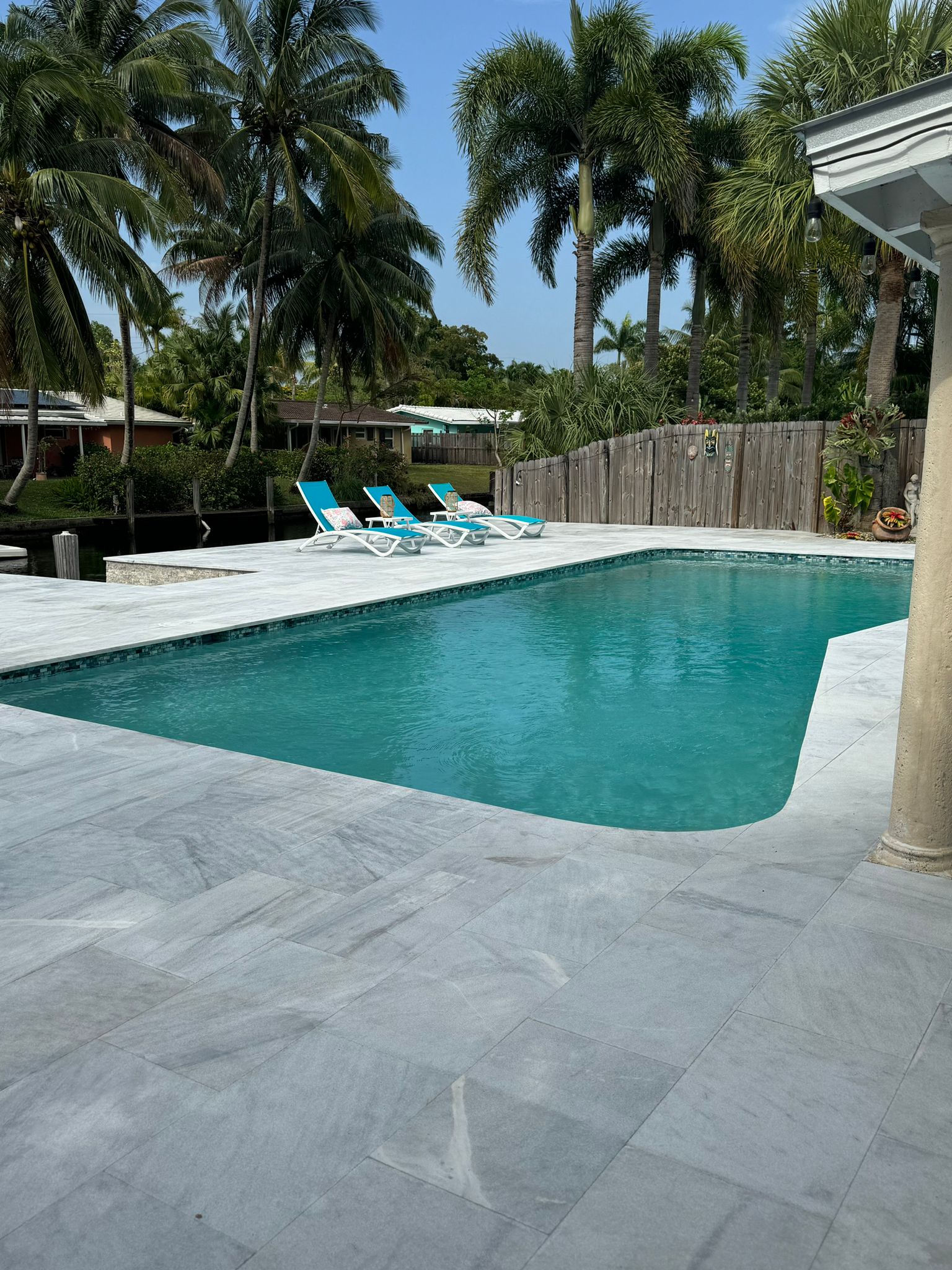
Start with the overall direction
Choose a broad visual direction before selecting individual products:
- Light and coastal
- Warm and natural
- Contemporary and restrained
- Tropical and colorful
- Resort-inspired
- Traditional
- High-contrast
- Monochromatic
Compare physical samples together
Place the proposed interior finish, tile, coping, and deck samples next to one another.
Review them:
- In direct sunlight
- In shade
- Near the home’s exterior
- Beside existing materials that will remain
- When dry
- When wet, if the product can be viewed appropriately that way
Screens and photographs can help narrow the options, but they do not reproduce texture, natural variation, scale, reflections, or changing outdoor light.
The South Florida pool-finish comparison explains why finish samples and photographs should guide a color direction rather than promise one exact water color.
Confirm exact products
The written selection should identify more than “blue tile,” “stone coping,” or “beige pavers.”
Record:
- Manufacturer
- Product line
- Color
- Size
- Finish or texture
- Pattern
- Edge detail
- Joint treatment
- Sealer or care requirements, when applicable
- Approved substitutions, if any
For physical comparisons, homeowners can also visit the Precision Pool Products showroom or contact the team before visiting to confirm that a particular sample is available.
A Practical Keep, Repair, Replace, or Evaluate Framework
If the interior surface is also showing stains, roughness, discoloration, cracks, or other visible changes, review the guide to the signs that a pool may need resurfacing before finalizing the larger project scope.
Use the table below to organize the conversation. It is not a remote diagnosis or substitute for an on-site assessment.
| Component | Conditions that may support keeping it | Conditions that may support repair | Conditions that may support replacement | Conditions requiring further evaluation | Coordination considerations |
|---|---|---|---|---|---|
| Pool interior finish | Surface remains serviceable and resurfacing is not currently needed | Limited conditions determined to be repairable after evaluation | Widespread wear, deterioration, unacceptable texture, or a planned finish change | Cracks, water loss, movement, hollow areas, or uncertain underlying conditions | Finish must coordinate with tile, fittings, steps, benches, lighting, filling, and startup |
| Waterline tile | Tile remains securely bonded, intact, and visually compatible | Limited missing grout or isolated damaged pieces where an appropriate repair is feasible | Loose, cracked, missing, repeatedly failing, or visually incompatible tile | Repeated detachment, unexplained cracking, movement, or suspected substrate problems | Confirm the transition between tile, coping, and the new interior finish |
| Coping | Units remain stable, intact, safe, and compatible with the deck | Isolated joints or individual units can be appropriately restored | Widespread movement, breakage, deterioration, or incompatibility with the planned deck | Recurring cracks, separation, settlement, or movement involving adjoining construction | Coping profile, elevation, edge, joints, and deck transition must work together |
| Pool deck | Surface remains stable, drains acceptably, and meets design goals | Problems are localized and matching repair material is available | Widespread deterioration, movement, drainage concerns, or a planned layout/material change | Settlement, recurring cracking, unexplained movement, or uncertain substrate conditions | Consider slope, drainage, elevations, access, coping, expansion or movement joints, and adjoining patios |
| Joint between coping and deck | Joint remains intact and accommodates the existing transition | Localized deterioration can be appropriately corrected | Broad failure or replacement of adjoining materials requires rebuilding the transition | Separation, recurring failure, water intrusion concerns, or movement between assemblies | Do not bridge intended movement areas with rigid materials without appropriate evaluation |
The most useful outcome is a written scope that places every component into one of four categories:
- Keep
- Repair
- Replace
- Evaluate further
“Evaluate further” is not indecision. It prevents a contractor or homeowner from pretending that a visible symptom proves something it does not.
Questions to Ask Before Finalizing the Scope
Use these questions when comparing proposals:
Existing conditions
- Which components appear serviceable?
- Which conditions are cosmetic?
- Which conditions affect function or installation?
- What cannot be determined until demolition or draining?
- Does any condition require evaluation outside the proposed scope?
Included work
- Is removal and disposal included?
- Are preparation and localized repairs described?
- Does the proposal identify which tile, coping, and deck areas will remain?
- Are transition areas included?
- Are filling and startup responsibilities identified?
- Are cleanup and protection of the property addressed?
Materials
- Are the exact manufacturers, product lines, colors, sizes, and finishes listed?
- Have substitutions been explained?
- Have physical samples been reviewed together?
- Is natural variation expected?
- Can replacement materials be matched to anything remaining?
Coordination
- What is the planned sequence?
- Who is responsible for each phase?
- How will completed work be protected?
- What happens if hidden damage is discovered?
- Will deck work affect coping, drainage, access, or elevations?
- Will future work require disturbing newly completed surfaces?
Final decision
A focused resurfacing project may be the right answer when the surrounding components are sound and the homeowner wants to preserve them.
A coordinated remodel may be the better choice when several adjoining components are deteriorated, incompatible, or already scheduled for improvement.
The scope should come from evidence and project goals—not from an automatic package.
Frequently Asked Questions
Q:Do I have to replace pool tile when resurfacing?
No. Existing waterline tile may sometimes remain when it is securely bonded, intact, compatible with the resurfacing work, and acceptable to the homeowner. Loose, cracked, missing, deteriorated, or incompatible tile may justify repair, replacement, or further evaluation.
Q:Should pool coping always be replaced during resurfacing?
No. Sound and stable coping may be kept. Replacement may deserve consideration when coping units move, crack, separate, create unsafe edges, conflict with planned deck work, or cannot be integrated appropriately with the new tile and interior finish.
Q:Does resurfacing a pool require replacing the deck?
No. Pool resurfacing addresses the submerged interior finish. The surrounding deck is a separate component. Its condition, drainage, movement, appearance, material compatibility, and the homeowner’s broader goals determine whether it should remain, be repaired, or be replaced.
Q:Is it less disruptive to replace tile and coping while resurfacing?
Coordinating the work may reduce duplicated draining, demolition, access, or protection requirements, but that does not mean every component should automatically be replaced. The practical benefit depends on the condition of the existing materials and the final project scope.
Q:Can only part of a pool deck be repaired?
Sometimes. Localized repairs may be appropriate when the surrounding deck remains stable and compatible material is available. Widespread movement, recurring cracking, drainage concerns, or significant material mismatch may make a larger scope worth evaluating.
Q:Can photographs show whether coping or deck cracks are structural?
No. Photographs can document the location and visible pattern, but they usually cannot establish the underlying cause, depth, movement, or severity. Cracks associated with settlement, movement, water loss, or recurring failure should be evaluated under appropriate on-site conditions.
Q:Should pool materials match exactly?
They do not need to be identical, but the interior finish, waterline tile, coping, deck, home exterior, and landscaping should relate intentionally. Reviewing physical samples together helps prevent individually attractive materials from competing once installed.
Q:What should a combined pool-remodeling proposal include?
It should clearly identify what will remain, what will be removed, preparation and repair responsibilities, exact material selections, installation sequence, transition details, filling and startup responsibilities, cleanup, exclusions, and how newly discovered conditions or requested changes will be handled.
Planning More Than Pool Resurfacing?
If the tile, coping, deck, and interior finish are all part of the conversation, define the complete scope before choosing materials or beginning demolition.
Precision Pavers & Pool Design can help you review the visible condition of each component, coordinate the material palette, and determine whether the project should remain focused resurfacing or become a broader pool-and-deck remodel.